

The Poverty Penalty: Why Being Poor Costs More — And How It Traps Children for Life
- admin /
- April 13, 2026
Poverty is often seen as a lack of money.
But in reality, poverty is far more expensive than wealth.
For millions of vulnerable children, being poor doesn’t just mean having less —
it means paying more for everything that matters in life.
Poverty is often seen as a lack of money.
But in reality, poverty is far more expensive than wealth.
For millions of vulnerable children, being poor doesn’t just mean having less —
it means paying more for everything that matters in life.
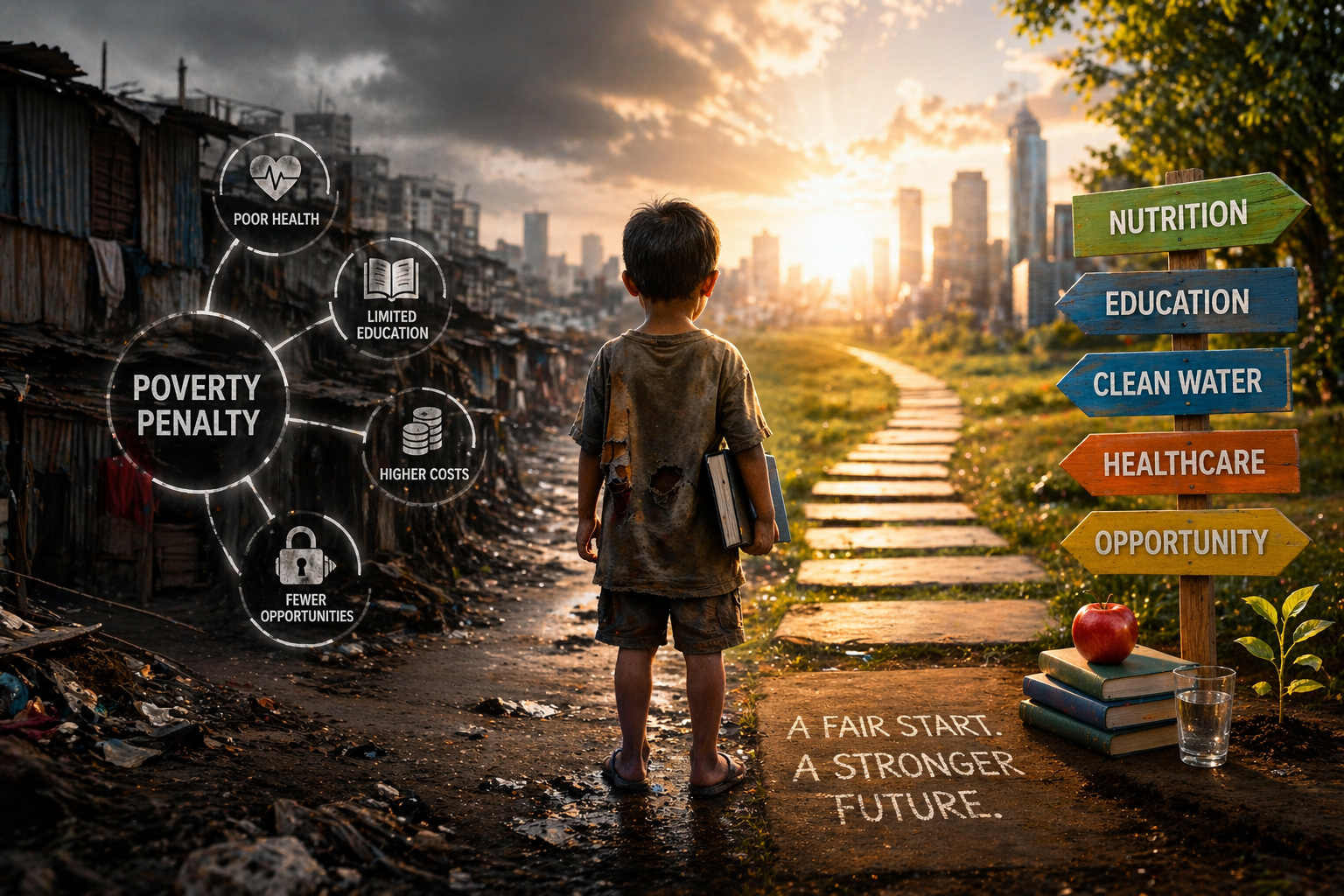
This is known as the “Poverty Penalty” — a hidden system where those with the least resources end up facing the highest long-term costs.
What Is the Poverty Penalty?
The poverty penalty refers to the extra costs people face simply because they are poor.
For children, this starts early and compounds over time:
- Paying more for low-quality food → leading to malnutrition
- Limited access to healthcare → higher medical costs later
- Lack of education → reduced earning potential
- Unsafe environments → higher risk exposure
According to global studies:
Children born into poverty are 2x more likely to remain in poverty as adults
Poor households can spend up to 30% more on basic necessities over time due to lack of access and options
How This Impacts Children the Most
For vulnerable children, the poverty penalty creates a cycle that is extremely hard to break.
Instead of building a future, they spend their early years recovering from disadvantages:
- Malnutrition affects brain development and school performance
- Irregular education leads to skill gaps
- Poor sanitation increases disease exposure
- Emotional stress impacts confidence and growth
This is not just inequality — it is a systematic disadvantage from day one.
The Long-Term Cost of Ignoring This Issue
The impact of this cycle doesn’t stop at childhood.
According to economic research:
- Individuals affected by early poverty can lose up to 40% of lifetime earning potential
- Countries lose 2–3% of GDP annually due to underdeveloped human capital
- Poor health in childhood increases adult healthcare costs significantly
In simple terms:
Ignoring vulnerable children today creates economic and social costs for the future.
Breaking the Cycle: What Actually Works
The solution is not just charity — it’s targeted, early, and consistent intervention.
When children receive the right support:
✔ Access to nutritious food improves health and focus
✔ Education creates long-term opportunities
✔ Clean water reduces disease risks
✔ Stable care builds confidence and resilience
Even small, consistent support can reverse long-term disadvantages.
From Burden to Opportunity
Here’s the powerful shift:
Supporting vulnerable children is not a cost — it’s an investment.
Global data shows:
- Every $1 invested in child welfare can generate up to $10+ in economic returns
- Educated children are twice as likely to contribute positively to their communities
- Improved child health reduces long-term public spending
Conclusion
The poverty penalty is real — and it begins in childhood.
If we don’t intervene early, children don’t just grow up in poverty —
they grow up paying the price of it for life.
But with the right support, this cycle can be broken.
Caroline Agnes Corp: Changing the Equation
At Caroline Agnes Corp, the mission is not just to support children —
it is to remove the invisible costs that hold them back.
By focusing on nutrition, education, clean water, and care, the organization helps children move from survival to opportunity.
Because when we remove the barriers…
children don’t just live — they rise.
Poverty shouldn’t cost a child their future — but without action, it often doe