

They Lost Their Parents. Now They're Losing Their Future.
- admin /
- May 21, 2026
Imagine losing your mother before you are old enough to understand what death means. Your father, gone before that. No one to pack your school bag. No one to nurse you when malaria burns through your body at night. No one to make sure you eat.
Now imagine that is not a rare tragedy. It is simply Tuesday — for millions of children across West Africa.
Imagine losing your mother before you are old enough to understand what death means. Your father, gone before that. No one to pack your school bag. No one to nurse you when malaria burns through your body at night. No one to make sure you eat.
Now imagine that is not a rare tragedy. It is simply Tuesday — for millions of children across West Africa.
A Crisis Too Big to Ignore
The numbers behind the global orphan crisis are staggering, yet they remain invisible to most of the world. An estimated 153 million children worldwide have lost at least one parent — a figure larger than the entire population of Russia. Over 52 million of those children live in Africa alone.
In sub-Saharan Africa, where poverty, disease, and conflict intersect with devastating precision, the orphan crisis is not just a humanitarian emergency — it is a generational one. According to UNICEF, 43% of orphans in sub-Saharan Africa live in extreme poverty, compared to just 13% of non-orphans. That gap is not a coincidence. It is the direct consequence of growing up without the single most powerful protective force a child can have: a parent.
Without parental income, orphaned children are pulled out of school earlier, malnourished longer, and exposed to exploitation, trafficking, and child labor at rates that non-orphaned children rarely face. The cycle is vicious — and without intervention, nearly unbreakable.
Benin: Where the Crisis Is Most Acute
While the orphan crisis spans the African continent, the West African nation of Benin carries a burden that deserves specific attention.
36.2% of Benin's population lives below the national poverty line. With children making up 45% of the total population, that poverty falls heaviest on the youngest and most vulnerable. According to UNICEF, one in three children in Benin is chronically malnourished — a condition that does not just affect the body. Chronic malnutrition stunts brain development, reduces cognitive capacity, and permanently limits what a child is able to learn, earn, and become.
The full picture is even grimmer: 36.5% of Beninese children are stunted, 8.3% are wasted, and 21% are underweight. Malaria remains the leading cause of death for children under five in the country. The children most at risk of all these outcomes are, overwhelmingly, orphaned children — those with no adult advocating for their health, nutrition, or survival.
A Classroom That Empties Before the Final Bell
Education is widely accepted as the most powerful pathway out of poverty. In Benin, that pathway is broken before most children can reach it.
According to World Bank data, only 54% of Beninese children who enroll in first grade reach the final year of primary school. Child labor, early marriage, and grinding poverty pull the other half out long before they develop the skills to change their lives. The national literacy rate stands at just 46% — far behind neighboring Nigeria at 62% and Togo at 67%. For girls, the figures collapse entirely: only one in ten young women aged 21 to 24 has completed secondary school.
For orphaned children, these statistics are not averages. They are ceilings.
Without a parent to pay school fees, provide meals, or simply insist that a child attend class, dropout is not a risk — it is the default outcome. A child who cannot read cannot escape poverty. A child without healthcare cannot survive long enough to try. A child drinking contaminated water is sick more than they are well. Every dimension of deprivation compounds the next, and orphaned children face all of them simultaneously — with no one watching.
This is why the orphan crisis in Benin is not simply a welfare issue. It is an education crisis, a health crisis, a water crisis, and a protection crisis — all happening to the same child, at the same time.
One Organization Refusing to Look Away
Caroline Agnes Corp exists precisely because someone refused to accept that these children's stories had to end this way.
A U.S.-registered nonprofit with its mission firmly rooted in Benin and surrounding communities, Caroline Agnes Corp operates where the need is greatest and the resources are fewest. Their work addresses the full reality of what orphaned and vulnerable children face — not one crisis at a time, but all of them together.
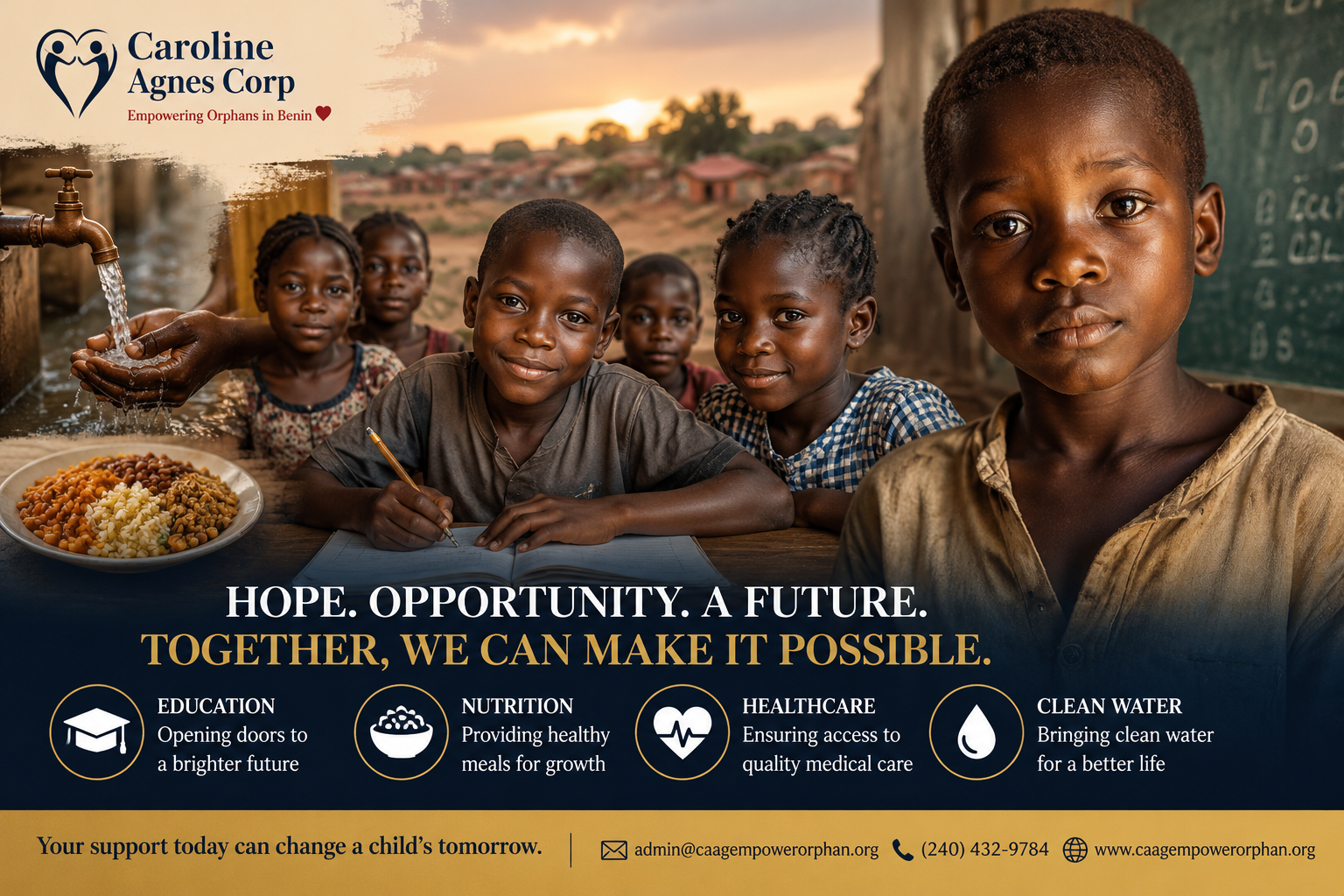
Through programs centered on education, nutritional food, quality healthcare, and clean water, Caroline Agnes Corp delivers the four pillars that determine whether a vulnerable child merely survives — or actually thrives. Their approach is not charity as a transaction. It is empowerment as a commitment — building children into capable, dignified human beings who can ultimately lift the communities around them.
Every child they reach is one fewer child falling through the cracks of a system that was never designed to catch them.
The children of Benin did not choose their circumstances. But we can choose our response.
Stand with the children who have no one else standing for them.
(240) 432-9784
www.caagempowerorphan.org
Caroline Agnes Corp — Empowering Orphans in Benin ❤