

4 Things Every Orphaned Child in Benin Needs to Survive — And Why the World Is Failing to Provide Them
- admin /
- June 23, 2026
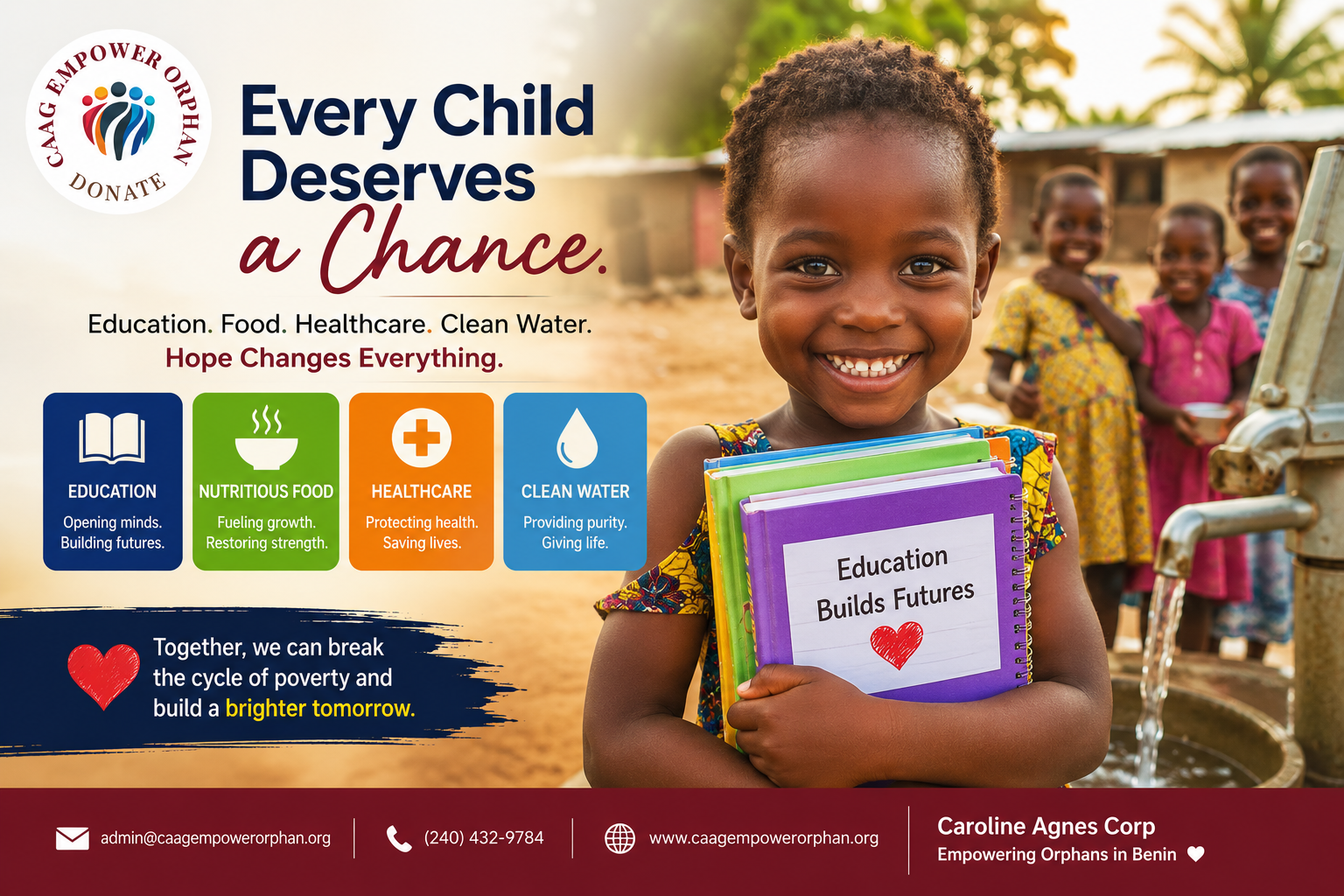
There are 150 million orphaned and vulnerable children in the world today. Most of them will never make the news. They will not trend on social media. Their names will not appear in a headline. They will simply grow up — or fail to — in communities that do not have the resources to give them what every child on earth deserves: food, water, healthcare, education, and love.
There are 150 million orphaned and vulnerable children in the world today. Most of them will never make the news. They will not trend on social media. Their names will not appear in a headline. They will simply grow up — or fail to — in communities that do not have the resources to give them what every child on earth deserves: food, water, healthcare, education, and love.
In the Republic of Benin — a small West African nation on the Gulf of Guinea — this reality plays out every single day, with devastating and largely preventable consequences.
Here is what the data tells us. And here is why it matters.
- Education: The Door That Keeps Closing
Education is universally acknowledged as the most powerful force for breaking the cycle of poverty. For orphaned children in Benin, that door is not just narrow — it is actively being shut.
About 36 percent of Benin's population continues to live in poverty — and when parents are absent, school fees, uniforms, supplies, and transportation become impossible barriers. Without an adult advocating for their enrollment and paying their way, orphaned children are among the first to be pulled out of school and among the last to return.
In four West African coastal countries including Benin, the spillover of the Sahel crisis has displaced 123,000 people — including 36,000 children — further disrupting already fragile education systems across northern regions.
The research is unambiguous: a child who does not complete primary education is exponentially more likely to remain in poverty for life, more vulnerable to child labour, early marriage, and exploitation, and far less equipped to contribute to the economic growth of their community.
For orphaned children, education is not a luxury. It is survival infrastructure.
- Nutritional Food: When Hunger Comes Before Learning
You cannot pour knowledge into a hungry child.
One-third of children in Benin are chronically malnourished — a figure that rises sharply among orphaned and parentless children who have no adult consistently ensuring they eat. Chronic malnutrition is not simply hunger. It permanently impairs brain development, reduces cognitive capacity, weakens the immune system, and creates a lifetime of disadvantage that no amount of later intervention can fully reverse.
Sub-Saharan Africa remains the only region where the number of stunted children continues to increase — with 62 million stunted children across the continent according to the UNICEF-WHO-World Bank Joint Child Malnutrition Estimates 2025. West and Central Africa sits at the heart of this crisis.
A child who is malnourished misses school more often. Falls behind faster. Drops out earlier. The relationship between nutritional food and educational outcomes is not theoretical — it is documented, consistent, and devastating when ignored.
Every nutritious meal given to an orphaned child in Lokossa or Grand-Popo is not just food. It is a foundation for everything that follows.
- Healthcare: The Crisis Nobody Sees Coming
In communities without reliable healthcare access, preventable illnesses do not just cause suffering — they steal time, disrupt schooling, and can be fatal.
UNICEF supplies Ready-to-Use Therapeutic Food and supports vaccination campaigns in Benin, where maternal and infant mortality rates — while falling — remain a significant challenge. For orphaned children, healthcare access is even more precarious. Without a parent to recognize symptoms early, advocate within healthcare systems, or afford treatment, illnesses that are manageable elsewhere become crises in Benin's southern communities.
Vaccinations, regular health checks, and nutritional supplementation are not aspirational goals for these children. They are the baseline conditions for survival. When they are absent, children do not just get sick — they miss months of school, fall permanently behind, and often never catch up.
- Clean Water: The Crisis Behind Every Other Crisis
Benin ranks 15th globally for the highest percentage of people without access to improved water sources — with 24.6 percent of the population relying on unimproved or unsafe water, according to WHO data.
Families in Benin's rural areas are often forced to travel long distances to collect water, and the drinking water they access is frequently contaminated — leading to waterborne diseases such as cholera, typhoid fever, and diarrhoea.
For orphaned children, this crisis compounds every other one. A child collecting water before dawn arrives at school late — or not at all. A child drinking contaminated water spends days sick. A child whose community lacks clean water grows up in a cycle of illness, lost education, and wasted potential that no single intervention can resolve alone.
Globally, 2.1 billion people still lack safely managed drinking water — with children in low-income countries facing the greatest disparities. Benin's orphaned children are among the most exposed.
The Organisation That Refuses to Choose Just One
Most aid efforts target one crisis at a time. Feed the children. Build a school. Sink a well. Each effort is valuable — but none of them, alone, is enough.
Caroline Agnes Corp provides medical help, nutritious food, vaccinations, education, job training, shelter for orphaned children, and clean drinking water — free of cost — to children in Lokossa and Grand-Popo who cannot afford these services otherwise. Since July 2024, CAAG has served 150 children across these two cities, with the explicit goal of serving more every year.
This is the distinction that matters. CAAG does not treat one symptom of a multi-layered crisis. It addresses all four pillars simultaneously — education, nutritional food, healthcare, and clean water — because it understands that for an orphaned child in Benin, these are not separate problems. They are one interconnected emergency that demands one coordinated response.
And above all else — CAAG provides love. The kind of consistent, dignified human presence that tells a child they are seen, they are valued, and they have a future worth building.
Every child you help today is a generation you change tomorrow.
(240) 432-9784
www.caagempowerorphan.org
Caroline Agnes Corp — Empowering Orphans in Benin ❤
Donate. Sponsor. Change a life: caagempowerorphan.org/donate_now