

The Children Nobody Is Counting — And What Happens When Someone Finally Does
- admin /
- August 25, 2026
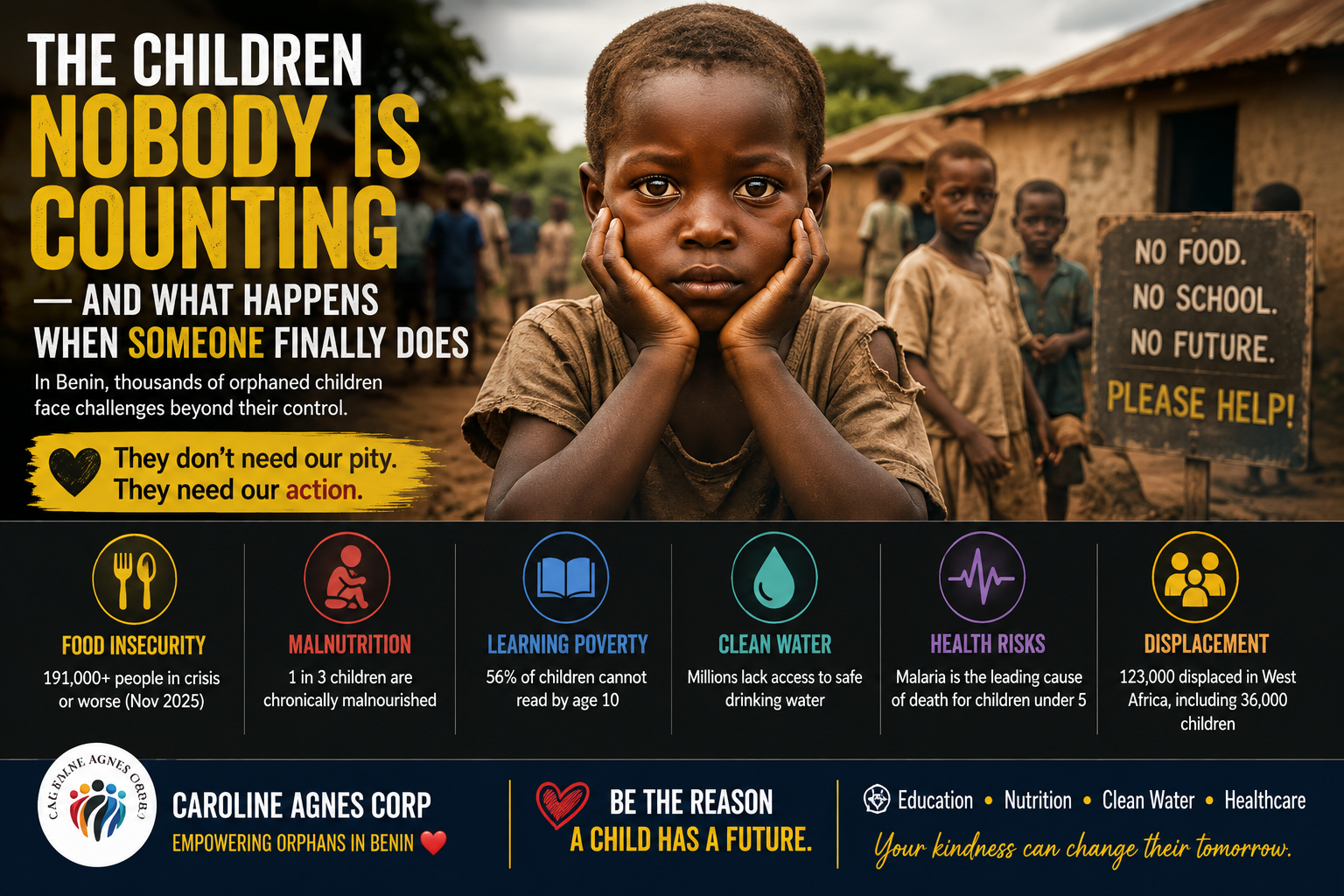
Here is a particular kind of invisibility that belongs to orphaned children in West Africa. Not the invisibility of darkness or distance — but the invisibility of being present in a crisis so large, so persistent, and so normalized that the world has learned to look past it without seeing it.
In the Republic of Benin, that invisibility has a number. It has many of them.
A Country Where the Numbers Tell the Whole Story
As of November 2025, 6.91 percent of Benin's population — more than 191,000 people — were facing crisis-level food insecurity or worse, with an additional 447,323 people in the stress phase. Behind those figures are children who went to school hungry, children who did not go to school at all, and children for whom the absence of a parent has transformed every one of these statistics into a personal reality.
About 36 percent of Benin's population continues to live in poverty, and one in three children is chronically malnourished. Chronic malnutrition is not simply hunger. It is a biological event — one that rewires a child's development before they are old enough to understand what is happening to them.
Up to 50 percent of children under five in Benin have developmental issues as a result of nutritional deficiency. Half of all young children. Not in a conflict zone. Not in a famine. In a country that exists quietly on the Gulf of Guinea, largely out of the frame of global attention.
The Compound Mathematics of Orphanhood
For a child with parents — even poor parents — the challenges above are survivable. There are adults to advocate, to share the burden, to notice when something is wrong and do something about it.
For an orphaned child, every one of those challenges multiplies.
According to the Centers for Disease Control and Prevention, malaria is the leading cause of death for children under five in Benin. When a child with no parent contracts malaria, there is no one to take them to a clinic before it progresses. No one to stay with them through the night. No one to ensure they finish treatment and return to school.
Benin's learning poverty rate — the share of children unable to read and understand an age-appropriate text by age ten — stands at 56 percent. More than half of all children. For orphaned children, who are more likely to miss school, drop out early, and never return, that figure is not a ceiling. It is a floor.
In four West African coastal countries including Benin, the spillover of the Sahel crisis has displaced 123,000 people — among them 36,000 children. These are children already living at the edge of what is survivable, pushed further by forces entirely beyond their control.
The Infrastructure of Neglect
What makes the orphan crisis in Benin so resistant to easy solutions is that it is not caused by one failure. It is caused by the systematic absence of every support structure that a child needs simultaneously.
Benin ranks 134th out of 146 countries on the Gender Inequality Index, with 36.5 percent of children stunted, 8.3 percent wasted, and 21 percent underweight. These are not temporary setbacks. Stunting in early childhood alters brain development in ways that no amount of later intervention can fully reverse. A stunted child enters school already behind, learns more slowly, falls further behind, and exits the education system — if they enter it at all — with fewer tools than every child around them.
Benin is currently off course to meet all global nutrition targets for which data exists — including stunting, anaemia, low birth weight, and exclusive breastfeeding rates. Off course. Not trending downward — off course. Moving in the wrong direction, or not moving at all, on every metric that determines whether the next generation of children will live healthier, longer, more capable lives than the one before them.
For orphaned children existing inside this system — without parents, without financial resources, without advocates — these numbers are not policy failures. They are the texture of daily life.
What Clean Water Has to Do With Everything Else
One of the most underappreciated drivers of child poverty in Benin is access to clean water — or the catastrophic absence of it.
When a child begins their day with a long walk to collect water, they arrive at school late — or do not arrive at all. When they drink contaminated water, they spend days sick — missing school, falling behind, losing ground they will struggle to recover. When illness becomes recurring, dropout becomes inevitable.
Water is not a standalone issue. It is the infrastructure beneath every other intervention. Feed a child well but give them contaminated water, and the nutritional gains vanish into diarrheal illness. Keep a child in school but deny them clean water at home, and attendance becomes irregular and eventually impossible.
This is the interconnected reality that defines life for orphaned children in Benin's southern communities — where every deprivation amplifies every other one, and where the absence of even one support pillar causes the entire structure of a child's development to buckle.
The One Thing That Changes Everything
Research is consistent on one point: when an orphaned child receives simultaneous access to education, nutrition, healthcare, and clean water — not one of these things, but all four together — the trajectory of their life changes in ways that are measurable, lasting, and transformative.
Education without nutrition produces a child who is in school but cannot learn. Nutrition without healthcare produces a child who is fed but frequently sick. Healthcare without clean water produces a child who recovers from one illness only to contract the next. And all three, without education, produce a child whose potential remains permanently untapped.
The solution is not complicated. It is simply comprehensive — and comprehensive solutions require organizations willing to show up for the whole child, not just one part of their problem.
Caroline Agnes Corp — Showing Up for the Whole Child
Caroline Agnes Corp is a U.S.-registered 501(c)(3) nonprofit serving orphaned and vulnerable children in Lokossa and Grand-Popo, Benin — providing education, nutritional food, healthcare, and clean water, free of charge, to children who have no other safety net.
Since July 2024, CAAG has served more than 150 children across these two cities. Each one of those children represents a data point that no government report will ever capture — a specific life, in a specific community, changed by the specific decision of someone who chose to act.
Every dollar donated to Caroline Agnes Corp goes directly to a child in Benin. Not to overhead. Not to administration. To school fees that keep a child in the classroom. To meals that build the brain of a future doctor, teacher, or community leader. To healthcare that means a child survives the illness that would otherwise end their story before it begins. To clean water that gives them the morning back — the morning they were spending walking, that they can now spend learning.
The children nobody is counting are in Lokossa and Grand-Popo. Caroline Agnes Corp is counting them. And with your support, they are being seen.
(240) 432-9784
www.caagempowerorphan.org
Caroline Agnes Corp — Empowering Orphans in Benin ❤