

The Girls of Benin Are Falling Behind — And the Window to Change That Is Now.
- admin /
- July 23, 2026
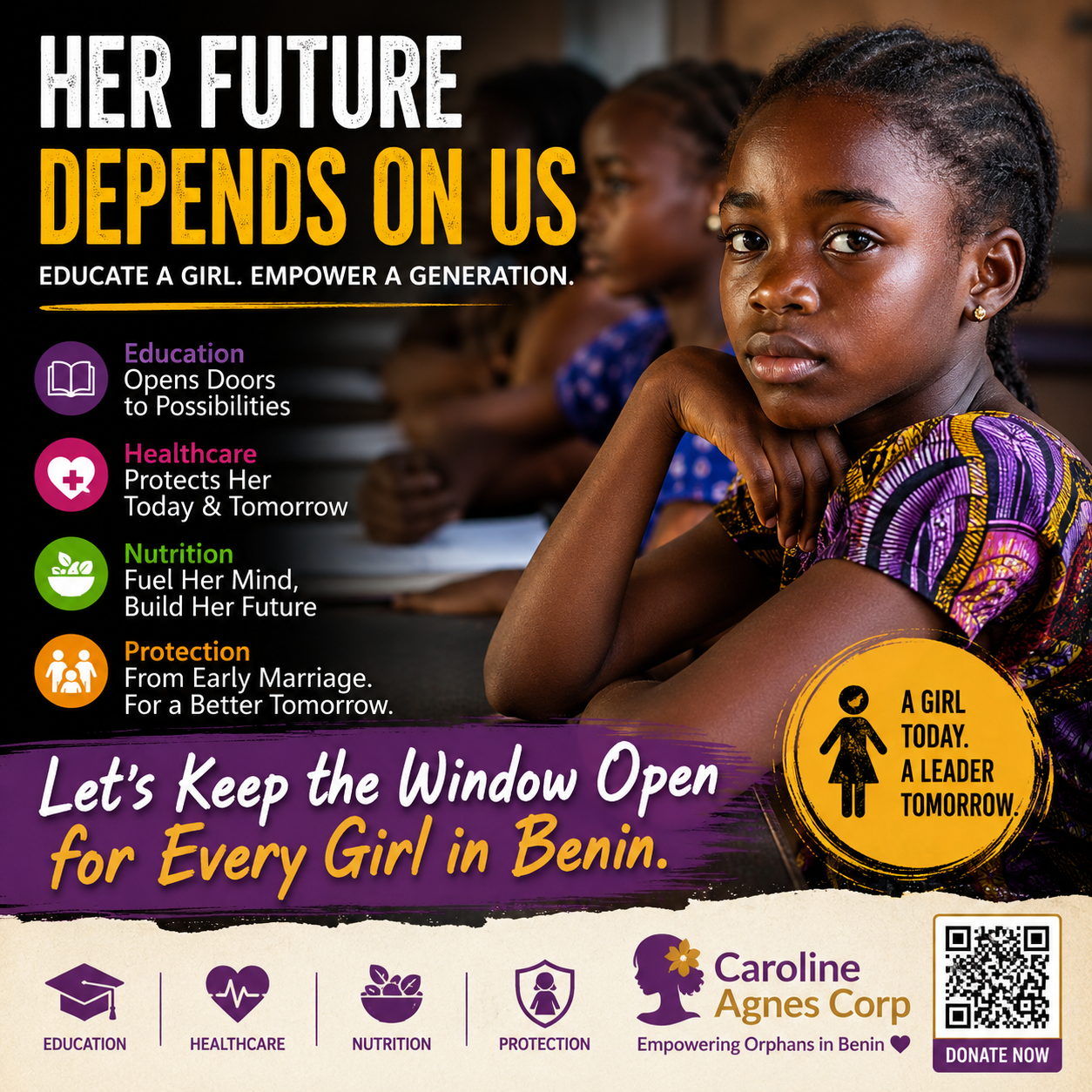
There is a moment in every girl's life in Benin when the future either opens or closes. It happens quietly, without announcement — sometime between her eleventh and fourteenth birthday, when a combination of school fees she cannot pay, a pregnancy she did not plan, or a marriage her family arranged takes her out of the classroom and puts her on a path she never chose.
There is a moment in every girl's life in Benin when the future either opens or closes. It happens quietly, without announcement — sometime between her eleventh and fourteenth birthday, when a combination of school fees she cannot pay, a pregnancy she did not plan, or a marriage her family arranged takes her out of the classroom and puts her on a path she never chose. By the time anyone notices, the window has already shut.
This is not a rare story in Benin. It is the most common one.
The Numbers Behind the Crisis
Only 25.2% of girls in Benin complete upper secondary education, according to the National Program for Accelerating Girls' Education published in July 2024 by the Beninese government with support from UNICEF. The gross enrollment rate for girls at the upper secondary level reached only 20.3% in 2022, compared with 26% for boys.
Primary school completion rates in Benin show clear gender gaps — girls complete at 70%, compared to 77% for boys, according to UNESCO Institute of Statistics data. But it is at the secondary level where the gap widens dramatically, and where the consequences become permanent.
Education authorities identify school fees as one of the leading causes of school dropout among girls. Early pregnancy and child marriage also continue to disrupt educational pathways. In the northern department of Alibori alone, secondary schools recorded more than 1,120 pregnancies during the 2021–2022 academic year.
These are not statistics produced in a vacuum. Behind each number is a girl who wanted to learn, who had something to offer, and who was failed by a system — and a society — that did not invest in her at the moment it mattered most.
Where the Gaps Are Deepest
The crisis in girls' education in Benin is not uniform. Regional disparities remain particularly pronounced in northern Benin, where the department of Alibori recorded a school enrollment rate of just 68.1% in 2022 across all education cycles.
In the south — in coastal communities like Grand-Popo and in the Mono department cities like Lokossa — the picture is different but not dramatically better. Poverty is more concentrated, family structures are more fragile, and orphaned girls face stacked disadvantages that compound with every passing year. A girl without a parent to advocate for her enrollment is significantly more likely to never return to school once she leaves.
Between 10 and 30 percent of girls dropping out of school can be attributed to early marriage or pregnancy, depending on the country, according to World Bank data. For girls already living in poverty or without both parents, those percentages rise sharply.
UNESCO estimates that if all girls completed secondary education, child marriage would drop by 64% — meaning that the solution to one crisis is contained inside the other. Education is not just the answer to illiteracy. It is the most powerful tool against child marriage, early pregnancy, and intergenerational poverty that any community possesses.
For each additional year of schooling, girls benefit through higher future earnings, delayed fertility, and reduced adolescent marriages — while also producing better outcomes for their future children.
The Four Areas That Need the Most Attention
Access to Education — The Fee Barrier
For most families in Lokossa and Grand-Popo, school fees are not a budget inconvenience. They are an impossible choice. When a family must decide between feeding children and paying school fees, education loses — and girls lose first. Sons are more likely to be kept in school when resources are scarce. Daughters are more likely to be married early, reducing the financial burden on the household.
Healthcare Access for Girls
Adolescent girls in Benin face health challenges that directly impact their ability to stay in school. Untreated illness, lack of menstrual health support, and inadequate nutrition create a cycle where girls miss school, fall behind, and eventually stop attending altogether. Without healthcare that reaches girls in their communities, educational interventions alone are insufficient.
Nutrition and Food Security
A girl who comes to school hungry is physiologically unable to learn at the level she is capable of. Chronic malnutrition, which affects a significant portion of children in Benin's southern coastal communities, impairs cognitive development long before its effects become visible. Nutritional support is not a supplement to education — it is a prerequisite for it.
Protection from Early Marriage
Reaching girls during adolescence is imperative because decisions made and behaviors established during this period can affect their entire life trajectory. Community education, family engagement, and consistent mentorship during the critical years between ages eleven and sixteen are what determine whether a girl stays in school or leaves it permanently.
What Caroline Agnes Corp Is Doing
Caroline Agnes Corp has been working with orphaned and vulnerable children in Lokossa and Grand-Popo for years — providing education, nutritional food, healthcare, and clean water to children who have no other safety net. Girls' empowerment is central to everything we do.
Through our Girls' Education and Empowerment Initiative, we directly address each of the four barriers described above:
We pay school fees, provide uniforms, supplies, and scholarships so that cost is never the reason a girl leaves the classroom. We provide mentorship that gives adolescent girls consistent adult guidance through the years when they are most vulnerable to dropout. We work with families and community leaders to challenge the norms that lead to child marriage. We provide healthcare access and nutritional support — because we understand that a girl cannot learn if she is sick, hungry, or afraid.
We have served over 150 children in Lokossa and Grand-Popo, and we are growing. But the need is vastly larger than what any single organization can address alone.
If this matters to you, please act today.
admin@caagempowerorphan.org
(240) 432-9784
Caroline Agnes Corp — Empowering Orphans in Benin ❤